16 Jul 2026
IDCA Unveils HDX™ at UN High-Level Political Forum Event
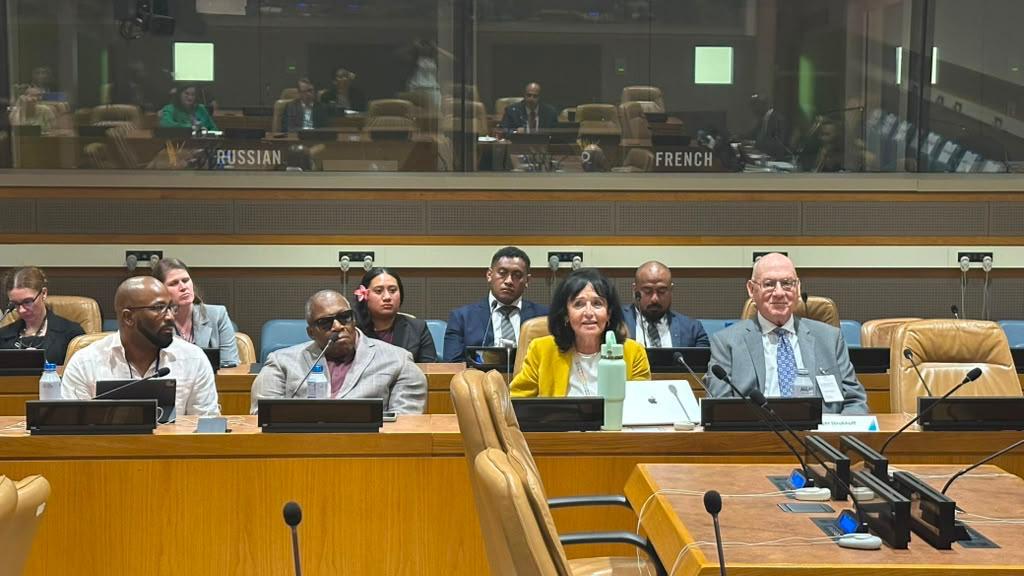
On Wednesday, 15 July 2026, on the margins of the UN High-Level Political Forum on Sustainable Development, the International Data Center Authority (IDCA) and the IDCA Global Foundation co-hosted the event “Human Dependency and the Future of the Multilateral System” with the Permanent Missions of the Republic of Fiji, the Independent State of Samoa, and the Commonwealth of the Bahamas, and the Konrad Adenauer Foundation New York Office. The event took place in Conference Room 7 at the United Nations Headquarters in New York.
The event convened delegations around a question the multilateral system must address expeditiously: as artificial intelligence transforms knowledge work, where do human beings remain essential, and how can institutions prepare early rather than react late? The seniority of the room reflected how seriously that question is being taken: the Ambassadors Permanent Representatives of Antigua and Barbuda, the Bahamas, Malta, Samoa, Tonga, and Trinidad and Tobago; the Permanent Missions of Fiji, Australia, New Zealand, and Libya; the Executive Office of the Secretary-General, UNDP, UNOPS, and the UN Office for South-South Cooperation; and partners including the Ford Foundation actively engaged with the topic.
At the event, Roger Strukhoff, Chief Research Officer of IDCA, introduced the International Data Center Authority and its standards work across more than forty countries. Dr. Simona Marinescu, CEO of the IDCA Global Foundation, presented the Foundation’s mission and the Human-Dependency Index (HDX™), shown to member states for the first time: five dimensions, physical presence, regulatory accountability, novel failure handling, cross-domain integration, and stakeholder trust, scored role by role to reveal where human intensity lives inside every organization, together with the first HDX findings for the multilateral system.
The presentation placed a three-step proposal before member states for the UN80 reform: an HDX baseline across a first group of UN entities, pilot hybrid role redesign, and certified capability built inside the system. It also carried an announcement: the HDX trademark is now registered in the United States, with European registration underway, and HDX Certification will follow, a mark that makes protection visible to workers, regulators, and markets.
The interactive discussion that followed showed exactly where this agenda is heading. Ambassadors and delegations posed questions on three themes: how the HDX can lead to improved skilling and reskilling programmes for people; what sovereignty means in the digital age; and how human-dependency evidence will be factored into the reform of multilateralism. These three questions, skills, sovereignty, and reform, are the agenda the HDX was built to serve.
IDCA and the Foundation thank the co-hosts and speakers: H.E. Ambassador Fatumanava Dr. Pa’olelei Luteru, Permanent Representative of Samoa; H.E. Ambassador Stan Smith, Permanent Representative of the Bahamas; the Permanent Mission of the Republic of Fiji; and Thomas Tödtling and Teresa Val of the Konrad Adenauer Foundation (KAS) New York Office. Small states led this conversation, as they have led so many that mattered.
The intelligence age has arrived without an adaptation strategy. On 15 July, the work of building one began.
About IDCA
International Data Center Authority (IDCA) is the global independent Digital Economy think tank that works with nations to create AI policies, Digital Hubs, and Digital Economies through the standardization of the approach, selection, design, feasibility, operation, and various processes and methodologies of digital infrastructure and related processes and systems. IDCA is represented in more than 40 countries and is active globally in the Americas, Europe, the Middle East, Africa, and Asia.
Follow us on social media:


.d57b427b.png&w=3840&q=75)