
Global Digital Economy Report (2026)
This report outlines the global Digital Economy as defined and researched by IDCA. This view of the Digital Economy is a distinctive view, that is, measures how digital technologies are being adopted internally, and how effectively they are being used by each nation of the world.
.b380a50a.png&w=64&q=75)


.2e81242a.png&w=256&q=75)
Download the report: Global Digital Economy Report (2026)
Executive Summary
This report outlines the global Digital Economy as defined and researched by IDCA. This view of the Digital Economy is a distinctive view, that is, measures how digital technologies are being adopted internally, and how effectively they are being used by each nation of the world. The size of the innate Digital Economy is derived from each nation’s Digital Readiness, which integrates hundreds of technology and socioeconomic factors into IDCA’s unique index.
The Digital Economy refers to the share of a nation’s economic and social activity that is enabled, scaled, or transformed by digital infrastructure, data, connectivity, platforms, and digitally skilled human capital. It reflects not only digital sectors and services, but a country’s underlying capacity to deploy technology across its economy in a sustainable, secure, and inclusive manner, supported by energy systems, governance, and workforce readiness.
The Digital Economy comprises 17.3 percent (%) of world GDP in nominal terms, according to IDCA research. This amounts to slightly more than US$20 trillion of approximately US$119 trillion of nominal global GDP in 2025. Nations now have between 3.7 and 25.4 percent of their economies classified as part of the Global Digital Economy, according to this research. The Data Centers of the world now consume 1.9 percent of the world’s electricity, with estimated consumption of 64-69GW as the foundation of the Digital Economy (See Figure 1).
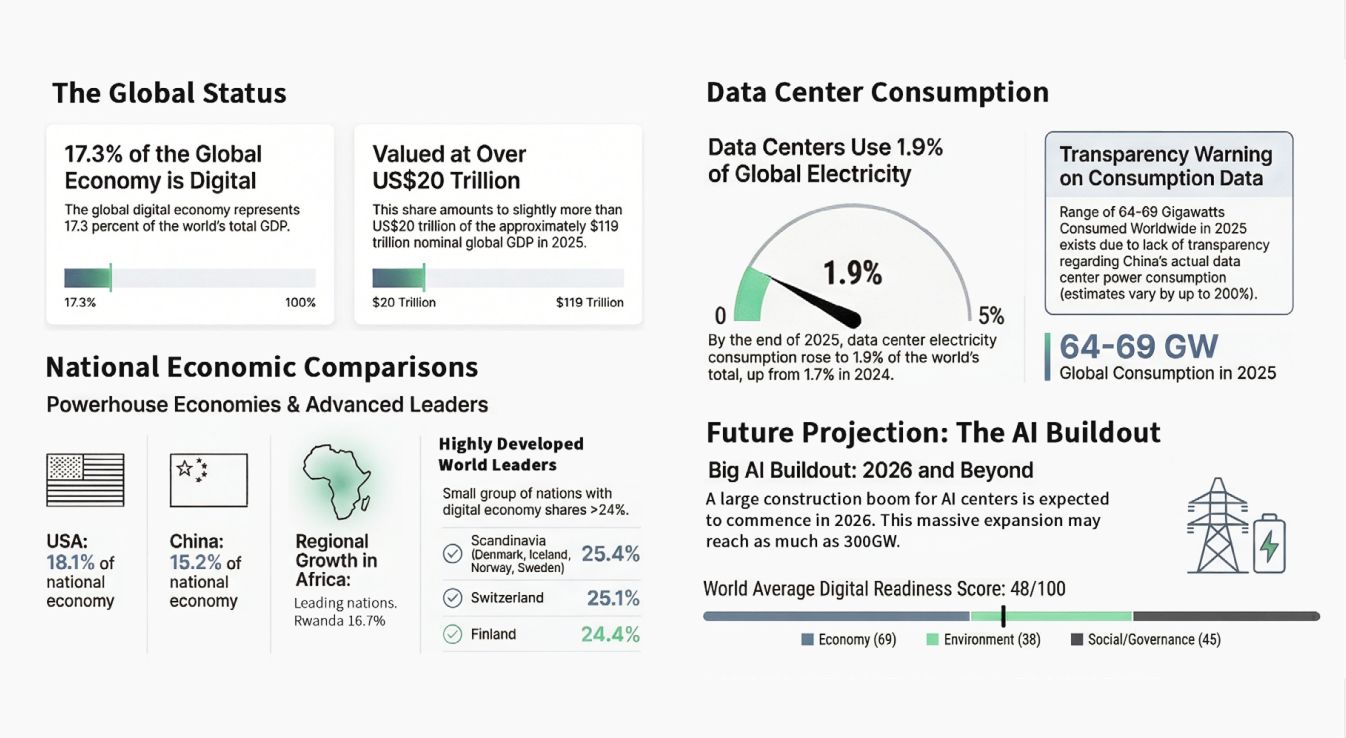
Insight
This report classifies the nations of the world into four specific phases of Digital Economy development, based on the underlying data provided by the IDCA Digital Readiness Index. The Index, in turn, integrates hundreds of technology and socioeconomic factors across the three broad categories of Economy, Environment, Social, and Governance. The Index can be viewed as an “EESG” analysis, applied to nations rather than corporations, augmenting traditional Environmental, Social, and Governance dimensions with explicit economic capacity metrics.
The Digital Readiness Index derives overall results that are then classified as a Pre-Phase Digital Economy, Developing (Phase I), Substantially Developed (Phase II), or Highly Developed (Phase III) Digital Economy.
As of 2026, there are five sovereign nations classified as Phase III Digital Economies, with one additional 10 Global Digital Economy Report 2026 aggregated regional reference (Scandinavia). There are 33 Phase II Digital Economies, 78 Phase I Digital Economies, and 56 nations in the Pre-Phase classification. Maps of the Phases are shown in Figure 2. The complete list of nations, their Digital Readiness scores, and their location within specific phases of the worldwide Digital Economy is found in in the tables below.
Digital Readiness Index overall scores, and their consequent Digital Economy Phase classifications, are expressed on a scale of 0-100 in this report. The underlying data, however, represents a consolidation of a variety of logarithmic and exponential data calculations and transformations. The 0-100 scale should be thought of as a non-linear expression that represents more of a percentile score than a simple arithmetic listing.
Trending Insights
IDCA News